

Golden Autumn: Color by Number
Excellent Coloring Pages
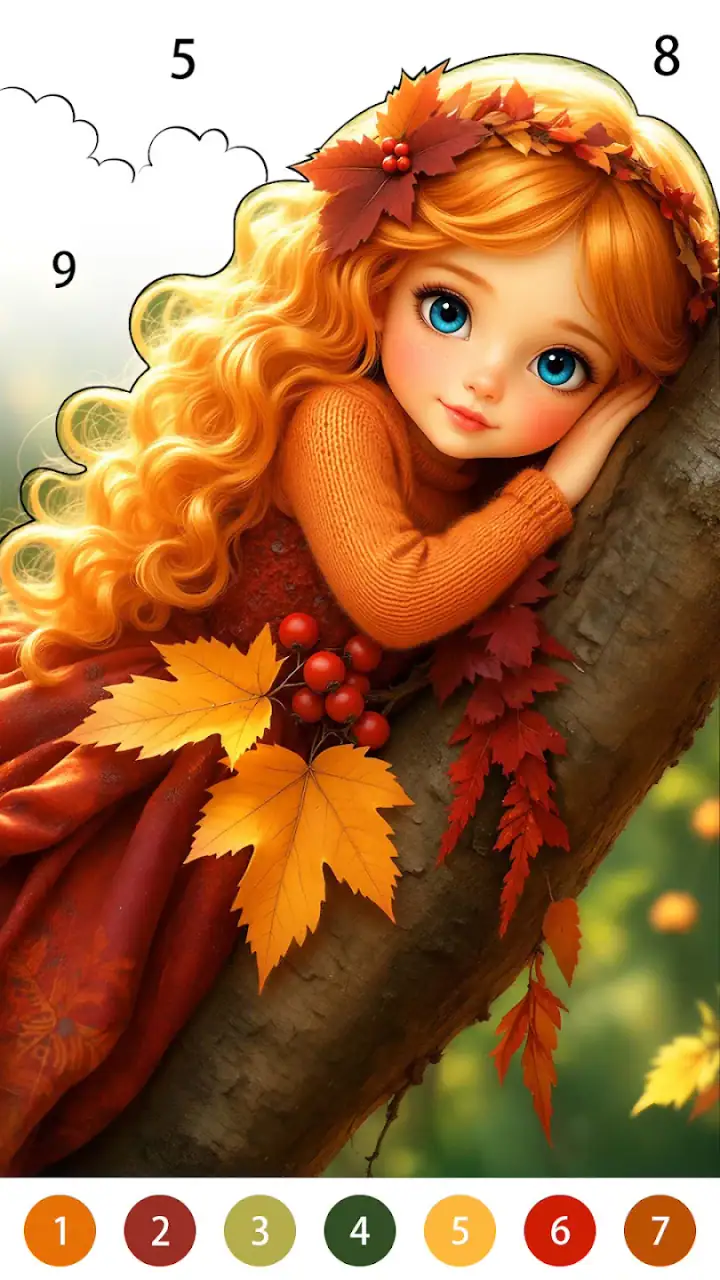
I opened Golden Autumn: Color by Number expecting a quiet coloring activity, and that is exactly where this board game works best. It is built around numbered coloring pictures with a warm fall and Thanksgiving theme, so the appeal is less about competition and more about settling into a small, repeatable task. The first few pictures are easy to understand: choose a color, find the matching number, and fill the marked areas until the image comes together.
That simplicity is not a weakness here. I can imagine using it after work, while waiting for an appointment, or on a slow weekend morning when I want something to do without learning complicated rules. The game is free to start, rated for Everyone, and runs on Android devices using version 7.0 or later. Its focus is narrow, but the narrow focus makes the experience immediately approachable.
How the early goals make the game easy to enter
The strongest early goal is simply completion. Each picture gives me a clear visual target, and the numbered spaces break the work into small actions. There is no need to understand a story, memorize a board, or plan several turns ahead. I can begin coloring within moments and see progress almost immediately.
That matters for younger players and for adults who do not usually play board games. The Everyone rating reflects the accessible presentation, although I would still treat the game as a relaxed creative activity rather than a traditional tabletop experience. Someone looking for dice, cards, direct competition, or strategic decisions will find a very different kind of board game here.
The autumn theme also gives the opening a consistent mood. Golden leaves, seasonal scenes, and Thanksgiving-related artwork make the pictures feel connected rather than randomly assembled. I found that useful because a recognizable theme can make a short coloring session feel more intentional. Instead of opening an empty canvas, I am choosing a seasonal illustration with a defined finish line.
Related News

Threads in Real Life: Who Should Join, Lurk, or Leave

How SHEIN Turned Shopping Into an Endless Content Feed

How to Make Fortnite Feel Smarter on Mobile

Should You Switch to Microsoft Outlook on Mobile?

Why Gallery Keeps Pulling Users Back

X Review: Why Its Network Still Matters
A practical tip is to start with a picture that looks moderately detailed rather than immediately choosing the most intricate artwork. Finishing one image early helps establish the rhythm of locating numbers, switching colors, and checking small spaces. After that, more detailed pages feel like a choice instead of a chore.
The developer is Excellent Coloring Pages, and the presentation stays close to that purpose. I would not install this expecting a deep campaign or a large collection of unrelated mini-games. The value is in having a steady supply of color-by-number scenes that are simple enough to use whenever I have a few spare minutes.
What progress feels like during an ordinary session
The progress signals are visual rather than narrative. A partially colored image gives me an obvious sense of movement, and every completed section reduces the remaining work. That is a good fit for short sessions because I do not need to reach a special checkpoint before stopping. I can make meaningful progress, put the phone down, and return later without losing the basic goal.
Gallery
I especially like this structure for divided attention. If I am listening to a podcast or sitting somewhere noisy, the game asks for enough focus to keep my hands busy but not so much that I must follow dialogue or remember a complicated sequence. The trade-off is that the activity can become repetitive during a long session. Its progress is satisfying in small portions, not necessarily as an extended marathon.
The game’s broader reception suggests that this straightforward loop has found an audience: it has a 4.7 average from around 8.5 thousand ratings, with roughly 1.5 thousand written reviews. I read that as a sign of dependable appeal rather than proof that every player will enjoy it. People who like calm, guided coloring are likely to understand the attraction quickly; players who need novelty every few minutes may not.
One useful workflow is to treat each picture as a separate mood-based activity. I might choose a simpler design when I want to relax, then reserve a more detailed scene for a longer break. This avoids turning completion into an obligation. The game works better when I decide how much attention to give it instead of trying to clear everything as fast as possible.
Another small advantage is that the numbered structure gives me a way to resume without wondering what to do next. The remaining marked areas tell me where to continue. That is more convenient than freehand coloring when I only have a short window and do not want to make creative decisions about composition, shading, or palette selection.
Difficulty is mostly about patience, not strategy
The difficulty curve comes from the size and density of the areas rather than from increasingly complex rules. Large sections are comfortable for warming up, while small spaces demand more careful tapping. As a picture becomes fuller, the challenge changes from recognizing the right number to maintaining attention and avoiding missed details.
That makes the game forgiving in one sense and limited in another. I am unlikely to feel blocked by a puzzle that requires a special trick, but I may feel slowed down by a crowded illustration. If I want intellectual challenge, deduction, or tactical pressure, this is not the right choice. A conventional board game or a logic puzzle would provide more meaningful decisions.
For a smoother experience, I would use a stylus if I already own one and find small touch targets tiring. I would also avoid rushing through the final areas of a detailed picture. The last uncolored spaces can be easy to overlook, and a slower scan is usually less frustrating than repeatedly tapping around to locate the missing section.
The seasonal artwork affects perceived difficulty too. A picture with many similar autumn shades can feel more demanding than one with broad, clearly separated areas, even when the underlying task is the same. I prefer to judge a page by how comfortable its details look on my screen, not by assuming that every image will take the same effort.
This is also where the game differs from ordinary coloring apps. Freehand coloring offers more personal control but can feel directionless. Color-by-number removes that creative burden and supplies a fixed route through the image. In exchange, I give up the ability to choose any color or reinterpret the scene. Golden Autumn is better for guided relaxation than for making an original artwork.
Unlocks and pacing without forced urgency
The pacing is strongest when I view completion as a gentle series of goals instead of a race. The attraction comes from finishing one seasonal image, then deciding whether I have the patience for another. That rhythm can support regular use because the activity is easy to restart, but it does not create the same urgency as a competitive game with opponents or timed rounds.
That distinction is important when considering retention. The game can bring me back through the comfort of its theme and the satisfaction of unfinished pictures, but I would not expect it to hold my attention through dramatic twists. Its retention pressure is light. It invites repetition rather than demanding it.
For me, that is a positive when I want a screen activity that does not become stressful. I can stop after a few minutes without feeling that I have wasted a long setup. On the other hand, players who enjoy daily streaks, leaderboards, escalating missions, or strong reward schedules may find the pacing too quiet. This is a game I return to because it is pleasant, not because it is pushing me to keep up with other people.
The free entry point helps with that casual role. I can try the core idea before deciding whether it belongs in my regular rotation. There are in-app purchases ranging from $1.99 to $59.99 per item, so I would pay attention to the purchase screen and treat optional spending as a personal choice rather than part of the basic reason to install it. Anyone looking specifically for a completely purchase-free experience should consider that point before settling in.
A sensible approach is to use the free portion as a test of the entire loop: complete enough artwork to learn whether the tapping, numbered matching, and autumn theme remain enjoyable after the novelty fades. If the routine already feels repetitive at that stage, buying additional content is unlikely to change the fundamental experience. If the routine feels calming, optional purchases may make more sense as a way to extend something I already like.
Who will enjoy it, and who should choose something else
I would recommend this game to people who enjoy guided coloring, seasonal artwork, and quiet activities that can be paused at any moment. It is also a reasonable choice for families seeking an approachable game with an Everyone content rating, provided an adult handles any purchase decisions. The controls and goals are easier to explain than those of most strategy-focused board games.
It suits a commuter waiting for a connection, someone winding down before bed, or anyone who finds repetitive visual tasks calming. In an everyday scenario, I might open it during a twenty-minute lunch break, finish a few sections of a fall illustration, and close it without needing to remember a storyline or protect a streak. That low commitment is one of its most useful qualities.
I would steer competitive players elsewhere. There is no reason to choose this over a card battler, digital chess, a tactical board adaptation, or a puzzle game if the main goal is to make decisions under pressure. I would also hesitate to recommend it to someone who wants unrestricted artistic tools. A drawing app or freehand coloring app would offer more expression, even if it required more effort.
It may not be ideal for people who dislike repetition or small touch targets. Detailed pages can turn relaxation into careful screen work, particularly on a compact phone. A larger display can make the numbered areas easier to inspect, while a smaller device may make the same picture feel more fiddly. That is not a flaw unique to this title, but it matters because the entire experience depends on comfortable tapping.
The autumn and Thanksgiving focus is another clear preference point. I enjoy a coherent seasonal identity, but players wanting animals, fantasy scenes, abstract patterns, or a broad year-round library may prefer a more varied coloring collection. The focused theme gives this game character, yet it also narrows its appeal.
How it compares with familiar alternatives
Compared with a physical coloring book, this game offers immediate number guidance and a cleaner way to correct the process of filling areas. I do not need pencils, an eraser, or a table, and I can carry the activity in my phone. The physical alternative still wins for people who enjoy paper texture, collecting finished pages, or stepping away from screens completely.
Compared with freehand digital coloring, Golden Autumn is easier to begin and harder to personalize. The numbered system tells me where to work, which is helpful when I want relaxation rather than artistic control. Freehand tools are better when I care about experimenting with color, creating unusual effects, or producing something that feels uniquely mine.
Compared with traditional digital board games, this one is much less social and strategic. Its board-game category is best understood through the structured, picture-based activity rather than through competition. I would choose it for calm repetition, not for playing against friends or testing a plan.
Compared with a general puzzle game, the challenge is gentler and more tactile. There is less risk of getting stuck, but also less variety in the kind of thinking required. That makes it useful for decompression, though not necessarily for keeping my mind sharply challenged over a long session.
Small frictions that affect long-term use
The main limitation is the narrowness of the loop. Once I understand the numbered coloring process, the game does not need much explanation, but it also has fewer ways to surprise me. The seasonal theme carries a lot of the personality, so anyone who does not connect with fall imagery may run out of enthusiasm sooner.
The second friction is the balance between relaxing and finishing. Large areas provide quick satisfaction, while highly detailed pictures demand patience. If I choose an image that is too intricate for the time available, I can leave the session feeling like I barely moved forward. Matching the picture to my available time makes a noticeable difference.
Spending is the third point to consider. The game is free, but the presence of item purchases means I would not hand the phone to a child without checking the device’s purchase safeguards first. I also would not assume that buying more content will add new types of gameplay; the core attraction remains color-by-number artwork.
Finally, the game’s calm pacing can feel passive. That is exactly what I want when I am tired, but it is not what I want when I am energized and looking for challenge. The best way to judge it is to ask whether I want a guided activity or a game that tests me. Golden Autumn is firmly in the first group.
My progression verdict
Golden Autumn: Color by Number succeeds because its early goals are obvious, its progress is visible, and its difficulty rises through detail rather than confusing rules. The pacing supports short visits and relaxed repetition. I can see why it has reached over 500 thousand installs: the concept is familiar, approachable, and easy to fit into ordinary moments.
Its progression is not deep in the strategy-game sense, and that should be understood before downloading. The rewards of play are completing pictures, enjoying the seasonal presentation, and maintaining a calm rhythm. Players seeking unlock-heavy systems, competition, or a demanding challenge should look toward another board or puzzle title.
For everyone else, I think the free starting point is worth trying. Give it a few sessions rather than judging it from one picture, and pay attention to whether the numbered process feels soothing or repetitive. If you like the autumn atmosphere and prefer guided coloring to blank-canvas creativity, this is an easy recommendation. I would keep it installed as a low-pressure way to occupy a spare moment, with the current version listed as 1.57.280 and the release dating from November 8, 2023.
My final view is positive but specific: this is not a game I would choose for excitement, mastery, or social play. I would choose it when I want a clear little task, seasonal images, and a finish line that never feels intimidating. Its best quality is the absence of pressure, and its biggest weakness is that the same calm simplicity may not be enough for players who need constant variety.
FAQs for Golden Autumn: Color by Number
What is Golden Autumn: Color by Number?
Golden Autumn: Color by Number is a relaxing digital coloring app focused on autumn-themed artwork. It provides numbered illustrations featuring falling leaves, warm landscapes, woodland scenes, pumpkins, and other seasonal designs. You select colors according to the numbered sections and gradually complete each picture. The app is aimed at casual players, coloring fans, and anyone looking for a calm activity rather than a competitive game.
How does the coloring system work in Golden Autumn: Color by Number?
Each image is divided into small numbered areas, with every number matching a specific color in the palette. You can tap the correct sections to fill them and zoom in when details are difficult to select. The straightforward controls make the app easy to understand, even for first-time users. Completing a picture usually feels gradual and satisfying, although some tiny areas may require patience.
Is Golden Autumn: Color by Number free to download and play?
The app can generally be downloaded without an upfront purchase, but the available content and features may depend on the version installed from the Android or iOS store. Some coloring pages, tools, hints, or other options may be offered through advertising or in-app purchases. Before downloading, it is worth checking the store listing for current pricing, subscription details, and any restrictions on premium artwork.
Does Golden Autumn: Color by Number require an internet connection?
Basic coloring may work without a continuous internet connection, particularly after the necessary artwork has been loaded onto your device. However, an internet connection may still be needed to download new pictures, display advertisements, synchronize progress, or access optional online features. If you plan to use the app offline, test the specific version on your device first, since offline availability can change after updates.
Is Golden Autumn: Color by Number suitable for children and beginners?
The simple tap-to-color design makes Golden Autumn: Color by Number accessible to beginners and older children who enjoy digital coloring. Nevertheless, parents should review the app’s age rating, advertising, in-app purchase settings, and privacy information before allowing younger users to play. Some detailed pictures can be challenging for small screens, while hints and zoom controls may help children complete more intricate designs.
Pros
- Relaxing coloring sessions suitable for unwinding after a busy day.
- Simple tap-to-fill controls make it accessible for beginners.
- Autumn-themed artwork creates a warm
- seasonal atmosphere.
- Helpful hints can assist when locating difficult color areas.
- Completed pictures are easy to save and share with others.
Cons
- Some detailed images may take considerable time to complete.
- Small sections can be challenging to select on compact screens.
- The seasonal theme may feel repetitive for some players.
- Hints and extra content may be limited without watching ads.
- Requires patience if you prefer faster-paced mobile games.


